
How Ashton Renovations manages construction schedules, coordinates trades, and adapts to the unexpected without compromising quality.
One of the most common questions homeowners ask during a renovation is, “When will my project be finished?” It’s a reasonable question. Renovations can be disruptive, and homeowners understandably want to know what to expect, how the work will progress, and when they can begin enjoying their newly renovated space.
However, unlike manufacturing or new construction, residential renovations—particularly in older homes—have many variables that make it difficult to predict an exact completion date. At Ashton Renovations, we believe the answer isn’t simply to create a rigid construction schedule with predetermined dates and hope everything goes according to plan. Instead, we use an Agile Project Management approach, which allows us to continuously review, coordinate, and schedule activities as the renovation progresses. Our goal is to maintain an organized, efficient construction process while prioritizing what matters most: quality workmanship, safety, and a successful finished renovation.
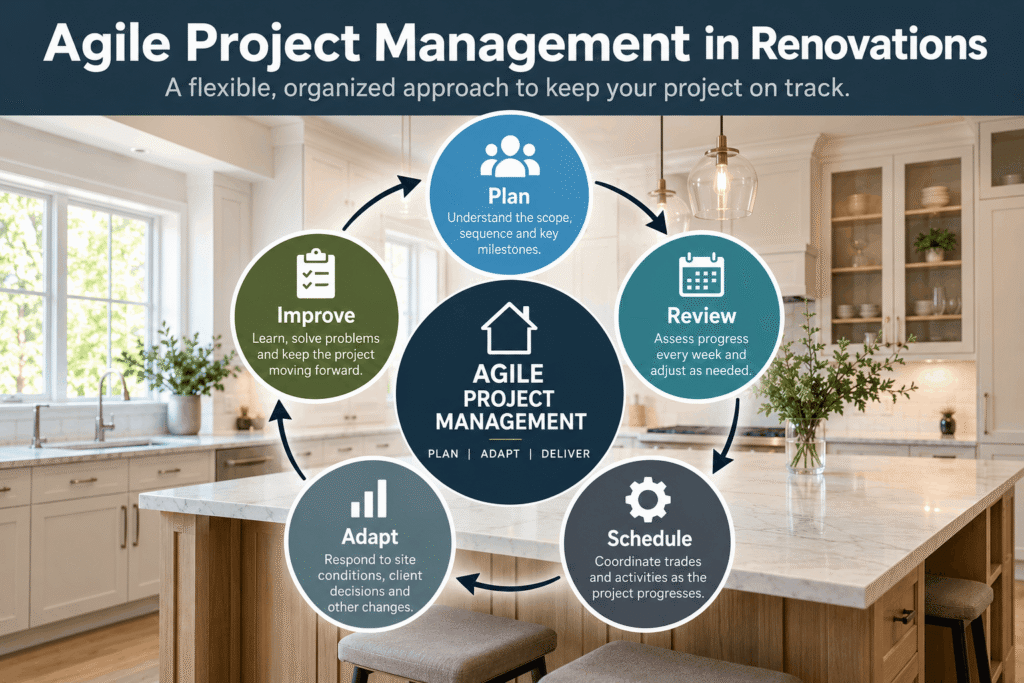
What Is Agile Project Management in Renovations?
Agile Project Management is an approach that emphasizes adaptability, collaboration, ongoing communication, and continuous improvement. Rather than assigning fixed dates to every construction activity months in advance, Agile Project Management allows us to focus on the current and upcoming stages of a renovation while maintaining an overall understanding of the work that remains.
This approach is particularly well suited to residential renovations, where unforeseen conditions, client decisions, material availability, and trade coordination can influence how work progresses.
At Ashton Renovations, our Agile approach includes:
- Establishing the overall sequence of construction activities in Buildertrend.
- Using “To Be Scheduled” placeholders for activities that have not yet been assigned dates.
- Reviewing upcoming construction activities every week.
- Scheduling trades and other activities as the project progresses.
- Collaborating with trades to coordinate the sequence of work.
- Identifying critical activities that affect the overall project timeline.
- Adjusting the calendar when site conditions or circumstances change.
- Conducting internal inspections and quality-control reviews between construction stages.
Agile doesn’t mean working without a plan. It means having a structured sequence of work while making scheduling decisions based on the most current information available.
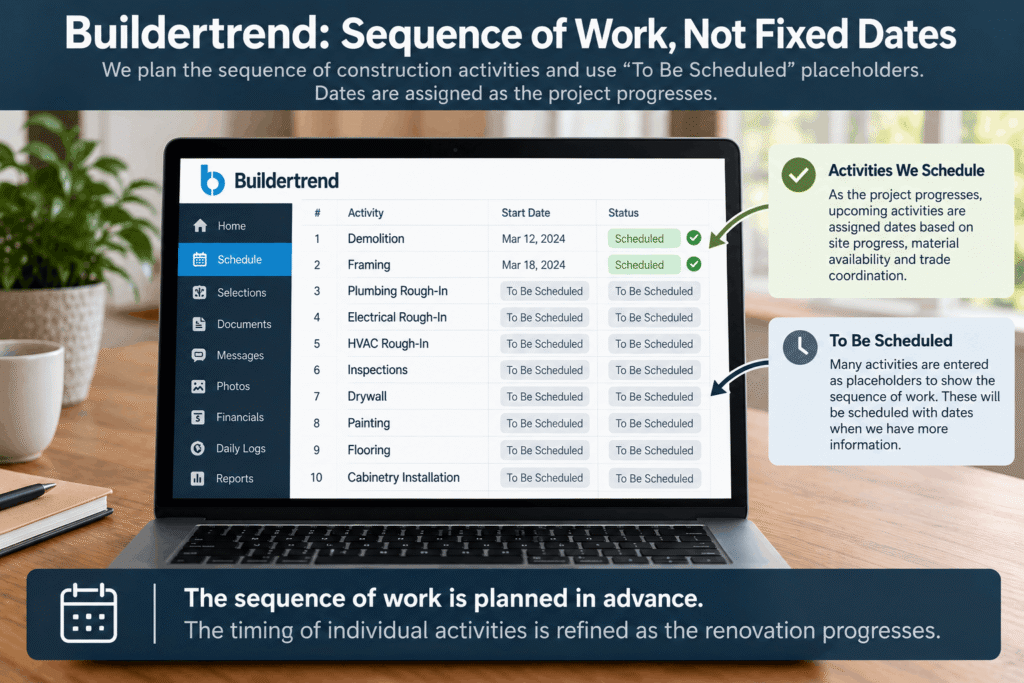
How We Use Buildertrend to Manage Construction Activities
We use Buildertrend, a construction project management platform, to organize and coordinate the many activities involved in a renovation. Our Buildertrend calendar includes construction activities and placeholders for client product and material selections, material ordering and deliveries, in-house construction activities, specialty subcontractors, municipal inspections, site visits, internal quality inspections, and important project milestones.
An important distinction is that not every activity has a scheduled date at the beginning of the renovation. Many activities are entered as placeholders marked “To Be Scheduled.” These placeholders establish the anticipated sequence of work and ensure that important activities are accounted for, even when their exact timing has not yet been determined.
The calendar provides a visual representation of how the renovation is expected to progress, somewhat like a Gantt chart, but without requiring every activity to have a fixed start and finish date. As construction advances, we assign dates to upcoming activities based on actual site progress, material availability, trade coordination, inspections, and other relevant factors.
For example, we know that drywall must follow the necessary framing, plumbing, electrical work, and applicable inspections. However, the exact date for drywall installation may remain unassigned until we have greater certainty about when those preceding activities will be completed. This approach allows us to maintain an organized construction sequence without creating unrealistic expectations around dates that may need to change.
The sequence of work is planned in advance. The timing of individual activities is refined as the renovation progresses.
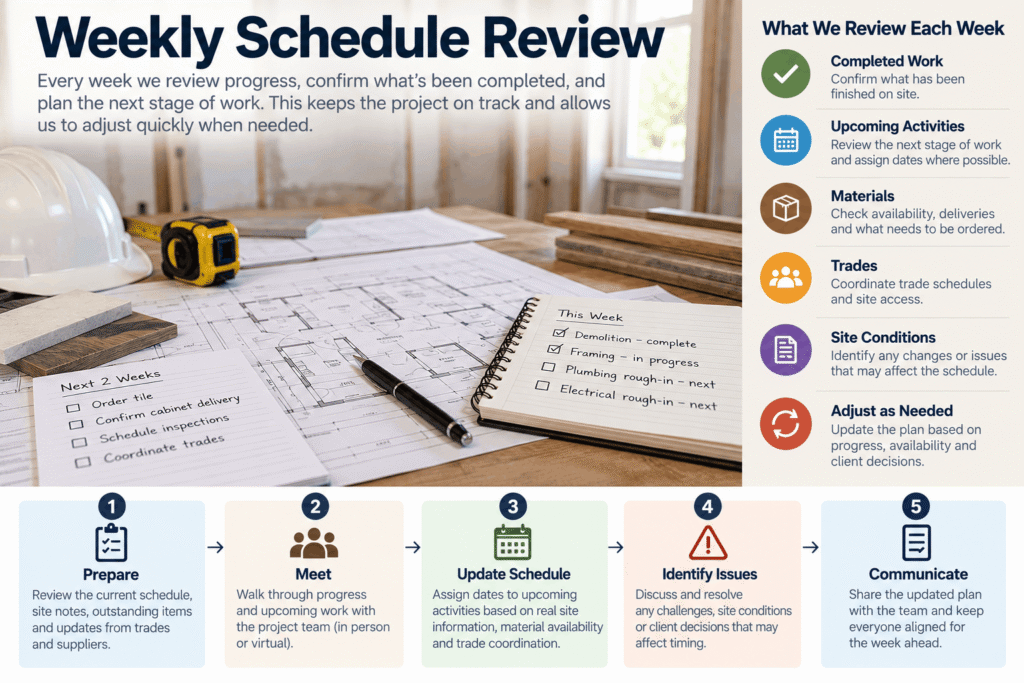
Weekly Scheduling Reviews: Agile Management in Practice
One of the most important parts of our scheduling process takes place away from the construction site. Every Sunday morning, our team meets to review the upcoming construction week. During these meetings, we evaluate what has been completed, review upcoming activities, identify potential issues, and update our Buildertrend calendar. Activities previously marked “To Be Scheduled” can be assigned dates when we have sufficient information to coordinate the work.
During our weekly reviews, we consider several important questions:
- What work has been completed, and what needs to happen next?
- Are the required materials available?
- Are the trades ready for their upcoming work?
- Have the necessary inspections been completed?
- Are there unresolved client decisions?
- Has anything changed that affects the next construction stage?
- Which activities can now be assigned dates?
- Do we need to adjust previously scheduled work?
This weekly review allows us to focus on the immediate stage of the renovation rather than relying on assumptions made weeks or months earlier. We maintain an overall sequence of construction activities, but our detailed scheduling focuses on the upcoming work, where we have more reliable information about site conditions, resources, and trade availability.
This is the foundation of our Agile Project Management process: establish the sequence, review progress, schedule the upcoming work, adapt, and move forward.
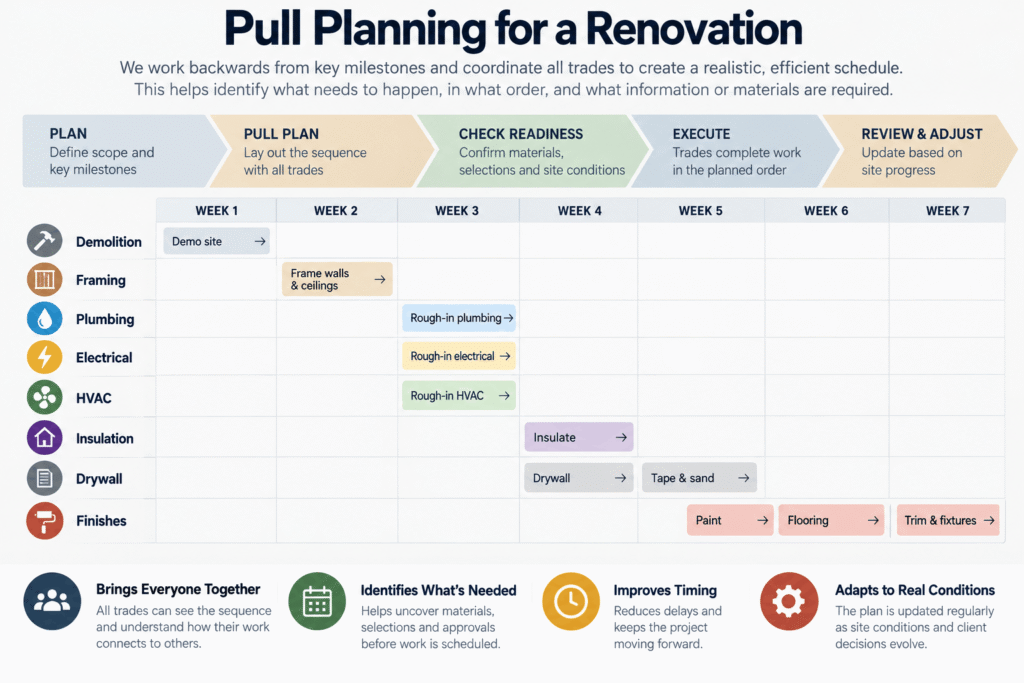
Pull Planning: Working Collaboratively With Our Trades
Construction scheduling should not be the responsibility of one person working independently of everyone else. At Ashton Renovations, we also use an internal pull-planning document, which is shared with our trades to help coordinate construction activities. Pull planning is a collaborative scheduling method commonly used on larger construction projects and associated with Lean Construction principles.
Rather than simply assigning dates to trades, the process considers the work that must be completed before the next activity can begin. For example, if cabinetry installation is planned for a particular date, we work backward to identify the preceding activities that must be completed, such as electrical and plumbing rough-ins, inspections, drywall, painting, and flooring where applicable.
Our trades can provide input on the sequence, timing, and practical requirements of their work. This collaborative approach helps us identify potential conflicts, improve coordination, and establish more realistic expectations. The people performing the work have valuable insight into how it should be scheduled.
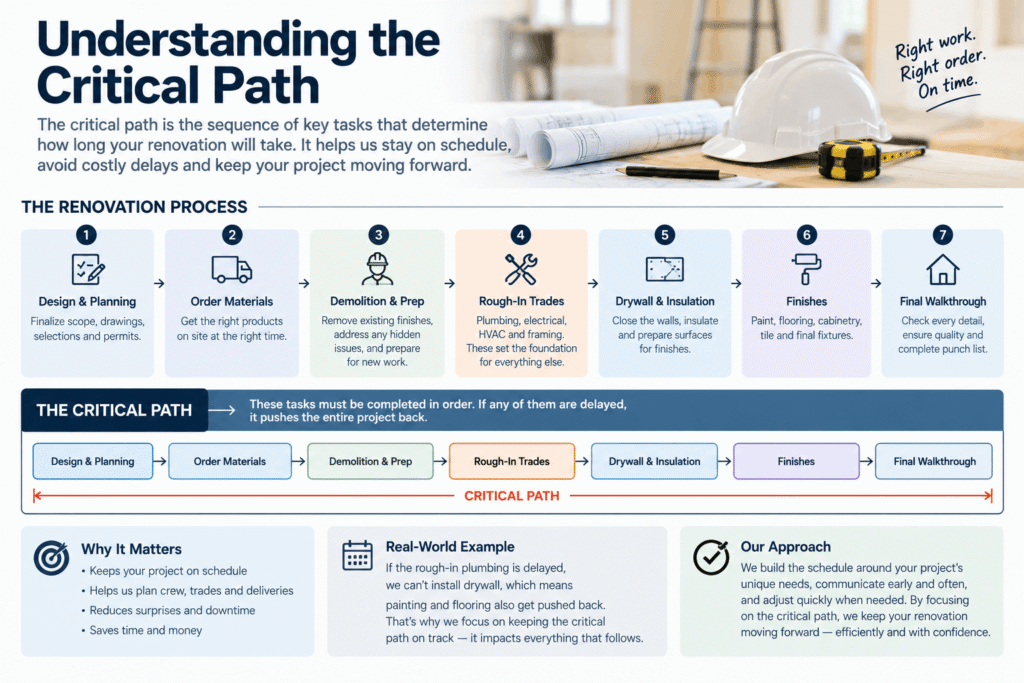
Understanding the Critical Path
Not every construction activity has the same impact on a project’s completion date. In project management, the critical path is the sequence of dependent activities that determines the earliest possible project completion date. Some activities have scheduling flexibility, while others must be completed on time to prevent delays to subsequent work.
Consider a kitchen renovation with cabinetry installation planned for a particular date. Before installation can proceed, several activities may need to be completed, including framing adjustments, plumbing and electrical work, inspections, drywall, and finishing. We work backward from this important milestone to assess whether the necessary preceding work can realistically be completed. If the timing is achievable, we coordinate and schedule the activities accordingly. If not, the cabinetry installation or other activities may need to be adjusted.
Other tasks may be completed earlier, later, or concurrently without affecting the overall project timeline. Understanding this distinction allows us to concentrate our attention on the activities that have the greatest influence on project completion.
Even when many activities remain “To Be Scheduled,” we remain aware of the critical milestones and dependencies that influence the overall renovation timeline.
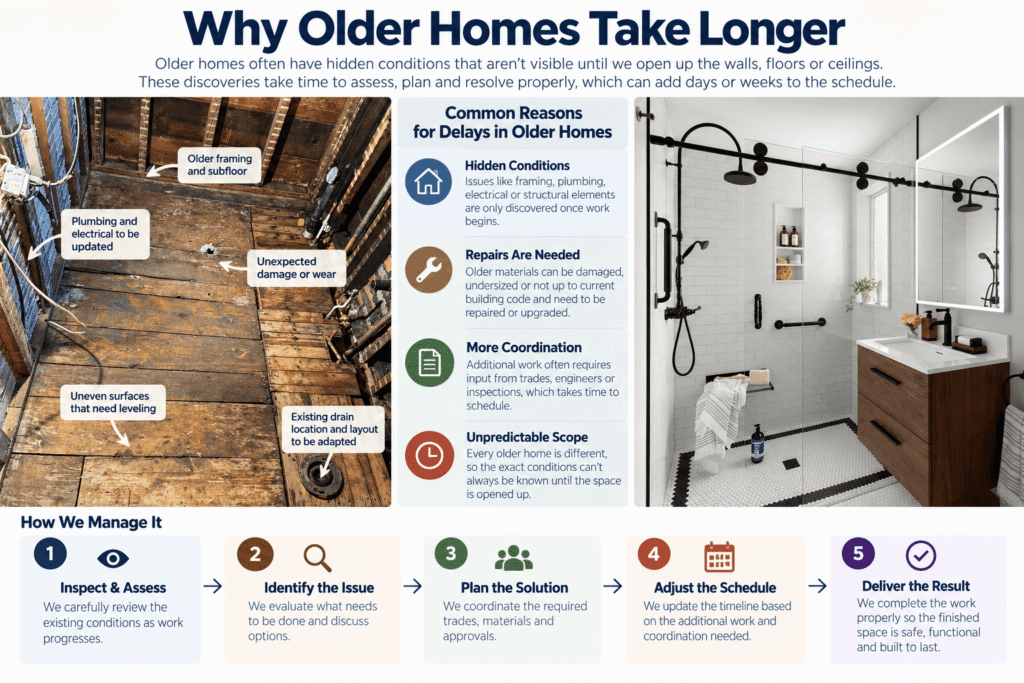
Why Renovating Older Homes Requires Greater Flexibility
Renovating an older home is fundamentally different from constructing a new building. With new construction, the project begins with a planned structure, known building systems, and a relatively predictable sequence of work. When renovating an older home, we’re working within an existing structure that may have been modified repeatedly over several decades.
Even with careful planning and preliminary investigations, certain conditions cannot be fully understood until walls, ceilings, or floors are opened. Common discoveries include:
- Structural deficiencies or unconventional framing.
- Outdated or improperly installed plumbing.
- Electrical systems requiring modifications.
- Asbestos or other hazardous materials.
- Previous renovations that were not completed correctly.
- Uneven floors, walls, and other irregular existing conditions.
These situations require more than simply adding another task to the calendar. They may require investigation, revised construction details, consultations with specialty contractors, inspections, or input from a professional engineer. Sometimes work must be temporarily paused while an appropriate solution is developed. This is not a failure of scheduling. It is a necessary part of renovating responsibly.
Older-home renovations require experience, problem-solving, and the ability to adapt to conditions that could not reasonably have been anticipated. Our Agile approach allows us to respond to these discoveries thoughtfully rather than rushing forward with an unsuitable solution.

Why Early Material Selections Matter
One of the most effective ways homeowners can help maintain a renovation schedule is by completing as many product and material selections as possible before construction begins. Selections are not simply aesthetic decisions. They frequently influence construction details, material lead times, and the scheduling of trades.
For example, the selection of a bathtub can influence plumbing locations and framing requirements. Kitchen appliances may affect electrical connections, cabinetry dimensions, and ventilation requirements. Cabinetry, tile, plumbing fixtures, lighting, flooring, and other materials can also have significantly different delivery timelines. When selections are made late, the resulting delays can affect multiple construction activities.
Our recommendation is simple: The more decisions that can be finalized before construction, the fewer avoidable scheduling disruptions are likely to occur. Although we can adapt to changes during a renovation, early selections provide a stronger foundation for an efficient construction process.
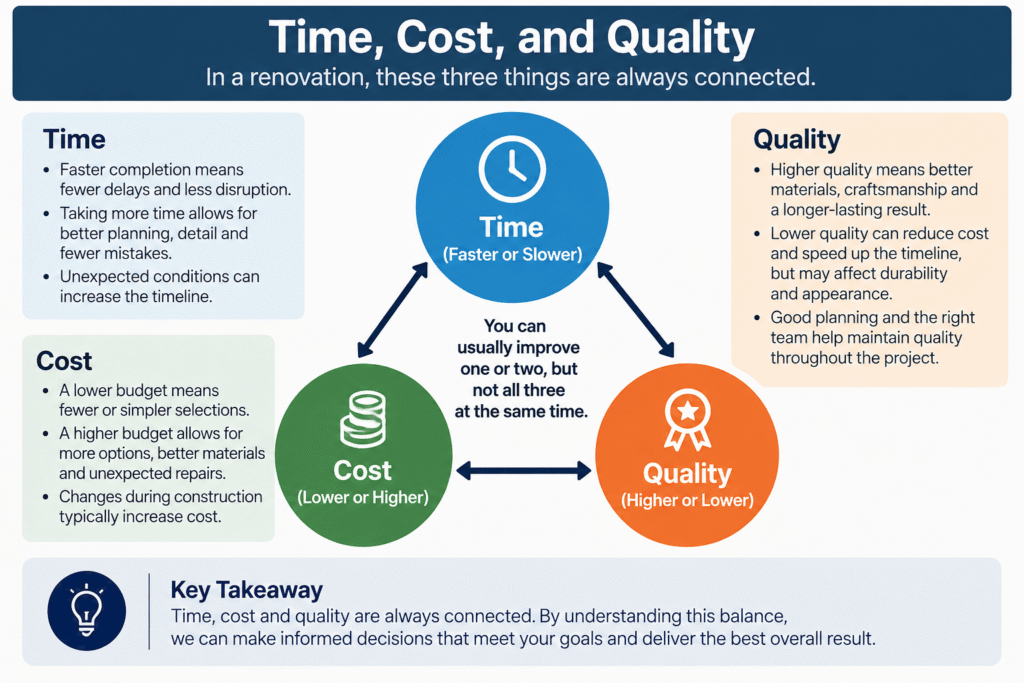
Time, Cost, and Quality: Understanding the Priorities
Construction projects involve an ongoing balance between three important considerations: time, cost, and quality. Reducing the time required to complete a project may involve additional labour, overlapping trades, overtime, or other measures that increase costs and introduce new risks.
At Ashton Renovations, our priority has always been quality. We recognize that homeowners want their renovations completed as quickly as reasonably possible. We share that objective. However, we will not compromise workmanship, safety, or the long-term performance of the renovation simply to meet an arbitrary date.
Good workmanship requires appropriate preparation, careful execution, inspections, and attention to detail. Rushing these activities can lead to mistakes, deficiencies, and rework, which may ultimately increase both the cost and duration of a renovation. Our objective is not simply to finish quickly. It is to complete the work properly while managing the schedule as efficiently as practical.
Why More Trades on Site Doesn’t Always Mean Faster Progress
It may seem logical that having more people working simultaneously would result in a faster renovation. In practice, residential renovation sites often have limited working space, and many construction activities must occur in a particular sequence. Having too many trades working in the same area can create congestion, interfere with workmanship, increase safety risks, and lead to mistakes.
For example, an electrician, plumber, drywaller, and cabinet installer cannot necessarily work effectively in the same small kitchen at the same time. In some circumstances, overlapping activities can improve efficiency. In others, it creates more problems than it solves.
Our scheduling process considers when trades can work concurrently and when they need separate access to complete their work properly. Effective scheduling is about having the right people on site at the right time—not simply having more people on site.
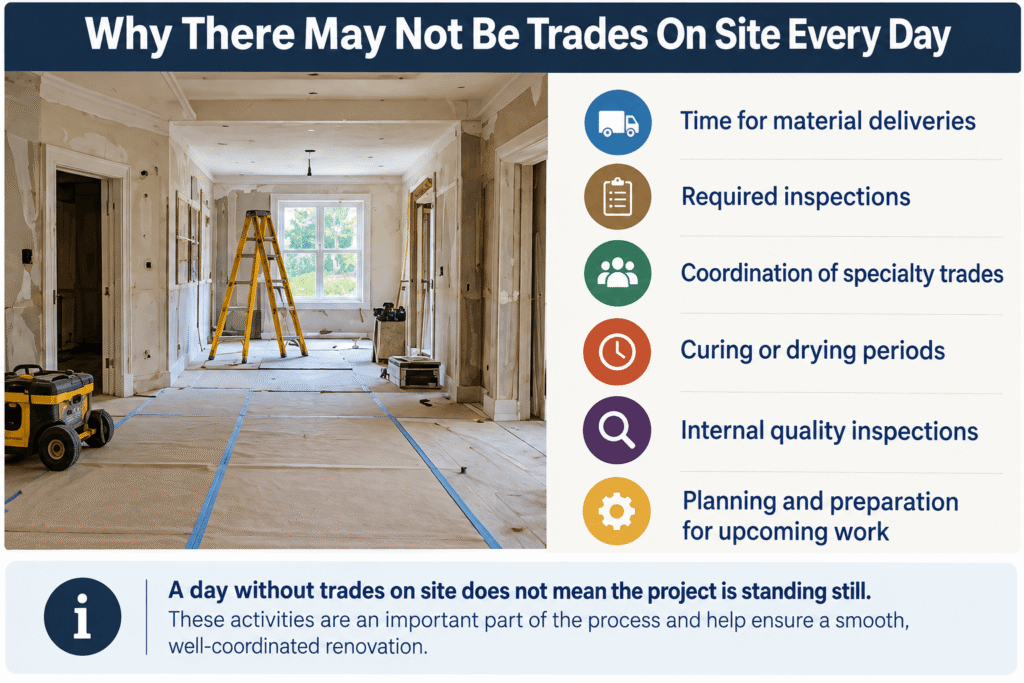
Why There May Not Be Trades on Site Every Day
One concern we frequently encounter is the expectation that someone should be physically working on a renovation every day. While some projects have continuous daily activity, many residential renovations do not. There are often intentional gaps between construction activities, and these periods serve important purposes.
They may allow time for:
- Materials to arrive or be prepared.
- Required inspections and approvals.
- Coordination of specialty subcontractors.
- Completion of necessary curing or drying periods.
- Internal quality-control inspections.
- Review of completed work before the next trade begins.
- Office planning, problem-solving, and preparation for upcoming activities.
These intervals are sometimes referred to as buffer periods, although not every gap represents unused scheduling time. For example, after one trade completes its work, our team may need to inspect the installation, review the next construction stage, and resolve outstanding details before another trade proceeds. This helps prevent mistakes from being concealed or carried forward into subsequent stages of construction.
A renovation involves much more than the physical labour taking place inside the home. There is also considerable planning, purchasing, coordination, administration, and quality control occurring behind the scenes. A day without trades on site does not necessarily mean that the project is standing still. In many cases, that time is helping us prepare for the next stage and protect the overall quality of the renovation.
Why We Cannot Always Provide an Exact Completion Date
We understand that homeowners need to plan around their renovations, and we make every effort to provide reasonable timeline estimates. However, an estimated completion date should not be confused with a guaranteed completion date.
The overall timeline can be affected by numerous variables, including:
- Unforeseen site conditions.
- Material lead times and delivery changes.
- Trade and specialty contractor availability.
- Inspection scheduling.
- Client selections and requested changes.
- Additional work identified during construction.
- The time needed to properly complete and inspect each stage.
Some of these factors are within our control, while others are not. This is precisely why we use an Agile scheduling approach.
Rather than assigning fixed dates to every activity at the outset, we establish the construction sequence and progressively schedule the work as the renovation advances. Our weekly reviews help us make scheduling decisions using current information rather than relying on predictions made long before the work takes place.
This does not eliminate uncertainty, but it allows us to manage it in a more practical and organized manner. Our objective is to provide homeowners with a realistic understanding of project progress while managing the many moving parts involved in a successful renovation.

Frequently Asked Questions About Renovation Scheduling
How long does a renovation typically take?
The duration depends on the size and complexity of the project, the age and condition of the home, the materials selected, and the extent of the work. We provide approximate timelines based on the anticipated scope. However, we do not necessarily assign dates to every construction activity at the beginning of the project. Instead, we establish the anticipated sequence of work in Buildertrend and progressively schedule upcoming activities through our weekly planning process.
Can we speed up the renovation by having multiple trades working at once?
Sometimes, but not always. Certain activities can be performed simultaneously, while others must follow a specific sequence. Too many trades working in a confined space can lead to congestion, safety concerns, interference, and workmanship issues. We prioritize effective coordination rather than simply increasing the number of people on site.
Will someone be working on my renovation every day?
Not necessarily. Most renovations include periods for material deliveries, inspections, trade coordination, internal quality-control reviews, and preparation for upcoming construction stages. These activities are part of the overall renovation process, even when physical construction is not taking place that day.
Why do renovations in older homes often take longer?
Older homes can contain unexpected structural, plumbing, electrical, or other conditions that are not visible before demolition. Resolving these issues may require specialized contractors, building inspectors, professional engineers, and additional planning. Working carefully within an existing structure often requires more time and adaptability than building from scratch.
What can homeowners do to help keep their renovation on schedule?
One of the most helpful things homeowners can do is finalize product and material selections early. Responding promptly to questions, reviewing proposed changes, and making timely decisions can also help reduce scheduling disruptions.
What happens when an unexpected issue is discovered?
We assess the issue, determine what additional information or expertise may be required, and develop an appropriate solution. If the discovery affects the construction sequence, we adjust the upcoming activities and coordinate the necessary next steps. Our priority is to resolve the issue properly rather than rushing ahead and creating further problems.

A Better Approach to Renovation Scheduling
At Ashton Renovations, we believe successful construction scheduling is not about assigning precise dates to every activity months in advance. It’s about establishing a clear sequence of work, understanding the dependencies between activities, collaborating with experienced trades, identifying critical milestones, and scheduling the work as reliable information becomes available.
Our combination of Buildertrend activity planning, weekly Sunday scheduling reviews, collaborative pull planning, and internal quality-control procedures allows us to manage renovations in a structured yet flexible manner. This is particularly important when working in older homes, where every renovation can present unique challenges.
Agile Project Management gives us the flexibility to respond to changing circumstances without losing sight of the overall project objectives. We understand that living through a renovation can be stressful, especially when the expected timeline changes or work is not visibly progressing every day. Our responsibility is to manage that complexity, coordinate the people and materials involved, and make thoughtful decisions throughout the process.
Because ultimately, a successful renovation isn’t simply one that finishes on a particular date. It’s one that is carefully managed, properly constructed, and built to be enjoyed for years to come.
Share This Post

Mark Ashton
Kitchen & Bath Designer
AKBD, CLIPP, B.A., B.A.S. (Mgmt.)
For over 25 years, Ashton Renovations has offered an innovative and professional approach to home renovations. From kitchens and baths to whole house projects, we can transform any room in your home.